Tuesday, November 5, 2013

How to Drive a Golf Ball

   For those who are looking to put their tee-shot in play, what follows are methods to improve the distance of your drive, learned through many rounds of golf and many hours on the rang.
Step 1:


      Have proper equipment. Today's equipment and balls are not necessarily tailored for 7 - 8 degree drivers. That is a thing of the past. Getting the ball up in the air on a good trajectory is the first step to driving the ball longer. Many touring pros regularly use 9 and 10 degree drivers and drive the ball 300 plus yards. Today's average driver loft for amateurs is 11.5 degrees. Plus, you will get much more consistency with a more lofted driver.

Step 2:


       Start with your front foot in line with the ball to give it more loft during the set up. When you go for your backswing, you should shift your weight backward. This will give your swing more power. 

Step 3:
      Use the proper grip pressure. Even though you may think that gripping harder and swinging harder produces results, that is absolutely incorrect and is probably why you don't get consistent distance. Cal Ripken, a hall of fame baseball player for the Baltimore Orioles, recently indicated to the Golf Channel that his grip pressure on the bat (on a scale from 1 being easiest to 10 being hardest) ranged from 2-4 for perfect release. The great Harry Varden,is given credit in the movies for this teaching, but actually instructing legend, Phil Galvano first introduced the idea that you will find that the great players indicated that the grip pressure should resemble one holding a bird without crushing it but also not letting it go. The tighter you hold the club, the less it will release throughout the ball. Hands must be tension free. Try it at the range and watch for the results.

Step 4:
https://blogger.googleusercontent.com/img/b/R29vZ2xl/AVvXsEj35izBayx6cB1voexhalBqZTWzp_5GsupbnwsLP4hVZwleBuAvh2Z9QfLjj2ovaq8Ct8Qg365BL5FrELTFpDFhNuR6uLbkXRTyZsuzIjOuSfG5QcMF4Yknn_GfjKQaTtkZKBhmywt0YZc/s320/w8.jpg
     Keep the start of your downswing calm and unhurried. This enables you to build up speed, so that the golf club is still accelerating when it reaches the ball.

Step 5:

      Stay flat. Your driving wood should stay along the ground for at least the first 20 to 25 percent of your swing. If your club is lifting up, you will pop the ball up and not get that long, boring drive that you see the pros hit regularly (when the ball takes off like a missile and slowly climbs to a beautiful height and tracks down the fairway).

Step 6:

     Keep the angle on your leading hand. Many amateurs tend to flip the hands forward in an effort to get the ball in the air, which defeats the purpose of having good equipment (as noted earlier). The leading hand (left hand for most players, right hand for southpaws) should be angled down towards the ball on the downswing. It's like you are hitting the ball with the back of left hand. If your left hand is flipping up on the downswing, your contact will not be solid and you will get consistent misses with your wood. Keeping the angle starts the ball low and lets it climb on its own through your generated power.

Step 7:


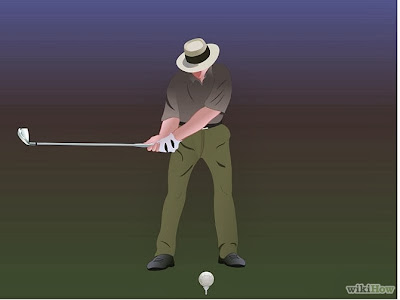
     Pick a spot on the ground that lines up with your target and, from your address, stretch your wood towards it. If done correctly, your arms should form a "V" shape with both arms fully extended. If you have a tendency to bend your left arm early, that will retard distance; keep your "V" as long as possible before it bends at the finish of your swing and you will find yourself getting much more distance.

Step 8:
https://blogger.googleusercontent.com/img/b/R29vZ2xl/AVvXsEj35izBayx6cB1voexhalBqZTWzp_5GsupbnwsLP4hVZwleBuAvh2Z9QfLjj2ovaq8Ct8Qg365BL5FrELTFpDFhNuR6uLbkXRTyZsuzIjOuSfG5QcMF4Yknn_GfjKQaTtkZKBhmywt0YZc/s320/w8.jpg

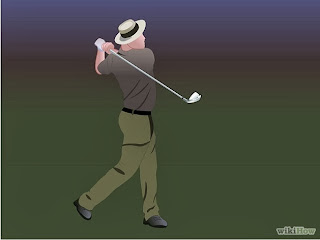
        Finish the golf swing over your left shoulder (for right-handed golfers) or right shoulder (for left-handed golfers). Don't be in a rush to look up and see where the ball went. If you did this correctly, the ball went straight.

Foraging for Fitness at the Driving Range


      (Reuters Life!) - Hitting golf balls at the driving range can lift the spirit, but does it also tone the flesh?
The exercise potential of swinging a club may be limited, experts say, but the more fitness you bring to the range, or the golf course, the stronger your stroke will be. "Most people don't think of the driving range or playing golf as a form of exercise, but it is," said Robert Yang, a sports performance coach and founder of the Performance Lab in Encinitas, California. "The professionals make it look smooth like butter but there's quite a bit of power and strength involved," Yang said. He explained that wielding a driver can be compared to hoisting a weight so heavy you can only lift it four times. "That's how much load or torque there can be on the body." But don't expect to swing your way to streamline shape. "The concept of getting in shape from just hitting balls is pretty tough." Yang said. "You wouldn't be able to change your body shape." The volume of exercise is simply not high enough. Yang said even on a golf course, people actually swinging the club for only two-and-one-half to three minutes. "The rest of the time you're just walking," he said. Conversely, Yang said fortune, on the golf course or on the driving range, favors the fit. Each body has physical limitations, whether it's lack of strength or flexibility. If you improve them, you'll hit the ball further," he said. "Whether 16 or 60, you should be focusing on strength and power training to improve your golf game." He said older, often more sedentary, golfers, can transform their game by working on their posture. "They'll stand up straighter. They're able to rotate more efficiently. That improves their golf swing." Yang said the fit golfer represents a fairly recent paradigm shift in a sport not typically regarded as requiring strength or speed training. "Tiger Woods basically started that whole thing," he said. "Younger players are much more into fitness, or they've been athletes all their lives." Taking a golf club back over your head, following through and moving your body to strike the ball, involves a range of motion not experienced by most people on a day-to-day basis, according to Kevin Burns of the American Council on Exercise. The good news is it benefits muscle groups in the core, back, shoulder and abdominals that might not get a lot of attention. The bad news is that's almost all there is. "Outside of adrenalin rush of striking the ball and hitting it a long distance, there's very little cardiovascular benefit," said Burns, a group fitness instructor based in Mankato, Minnesota. Burns said the driving range compares unfavorably to the golf course. "Walking nine to 18 holes has tremendous cardiovascular benefits, especially if you do it on a regular basis," he explained. Any activity that will get someone off the couch and moving is a good activity, he said , but an overall fitness plan should include cardiovascular, range of motion and weight-bearing exercises. Yang concurs. "If your goal is just to swing a club and be active, then you'll achieve the goal," he said. "If you're looking to lose five inches on your waist, that's not going to happen."

Share

Twitter Delicious Facebook Digg Stumbleupon Favorites